

Threat Prevention
Early intervention is a critical component of the Rhodes College Threat Assessment Team's efforts to assess, manage, and mitigate potential threats: Preventing violence and supporting the safety of the campus community are responsibilities of all members of the Rhodes College community. Campus safety is supported through the early identification and timely reporting of indicators of potential concern with the Threat Assessment Team.
Mission Statement
The Rhodes College Threat Assessment Team (RCTAT) promotes a safe and secure campus environment. Our mission is to proactively identify, assess, and manage potential threats to the safety and well-being of the campus community through collaborative efforts, preventive measures, and coordinated responses.
Resources
911
Rhodes Campus Safety 901-843-3880
Student Counseling Center 24-7 1-855-850-4301
Concern (Rhodes Employee) 901-458-4000
Rhodes College Threat Assessment Team (RCTAT) +
Main Team members come from the following areas:
• Department of Campus Safety, Chair
• Division of Student Life
• Student Counseling Center
• Dean of Students
• Residence Life
• Department of Human Resources
• Office of the Provost
• Title IX
• Additional as needed team members
• Student Accessibility Services
• Athletics
• Legal Counsel
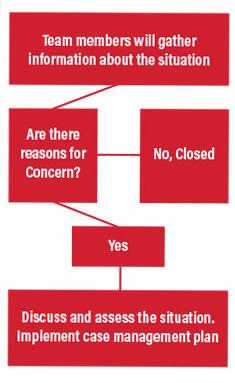
RCTAT Investigation Process
If the threat is immediate:
Call Rhodes Campus Safety at 901-843-3880
If the threat is not immediate:
Email RCTAT@Rhodes.edu with as much information as possible to identify the person of concern and the behavior.
Report to RCTAT Behaviors Such As >>
1. Threats and Threatening Communications:
- Threats, threatening communications, and or writings including direct, indirect, veiled, or conditional threats.
- Leakage of violent intent, violent fantasies, or communications expressing plans, grievances, or support for violence.
- Bullying, harassment, stalking, coercive behavior, intimidation, or relationship violence.
2. Aggression and Concerning Behavior:
- Escalating anger, hostility, aggression, assaults, property destruction, or cruelty toward animals.
- Disruptive or concerning conduct that impacts the safety or well-being of others.
- Repeated violations of conduct standards, no-contact orders, or institutional directives.
3. Violence-Supportive Beliefs:
- Perceived injustices, victimization, hopelessness, revenge-seeking, or beliefs that violence is the only solution.
- Significant personal, academic, employment, legal, disciplinary, or financial stressors accompanied by escalating concerning behavior.
4. Violence Fixation:
- Excessive interest in targeted violence, attackers, weapons, tactical methods, violent ideologies, or violence-related notoriety.
- Recent law-enforcement contact involving violence, threats, weapons, vandalism, or hate crimes.
5. Planning and Preparation:
- Behaviors and or writings that indicate preparation for violence, including weapon acquisition, surveillance, attack research, rehearsal, or planning.
6. Crisis and Mental Health Concerns:
- Suicidal ideation, self-harm, homicidal ideation, or other crisis situations requiring intervention.
- Substance misuse associated with impaired judgment, aggression, or escalating concerning behavior.
- Concerns raised by students, employees, parents, or community members regarding unusual, escalating, or concerning behavior.